
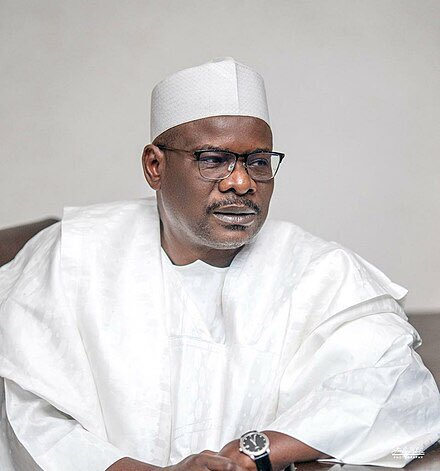
Senator Ali Ndume, a member of the All Progressives Congress representing Borno South in the Senate, has raised concerns over the management of funds borrowed by the President Bola Tinubu-led administration.
In an interview with Arise TV, he stated that over ₦13 trillion has been borrowed under the current administration.
However, he pointed out that most of these funds have not been spent on infrastructure, and alleged that some of the loans did not receive Senate approval.
“Let me first of all say this, I am not against borrowing. Even the greatest countries in the world—America, Japan, China—all are big borrowers. But they borrow for physical, tangible, accountable projects. They spread and pay over time. My worry is not even the borrowing; it is what you borrow for.”
“Let me give you a rundown of what I am saying. In June 2023, $500 million was borrowed for women programmes to scale up. Can we see that? Can Nigerians see it? Where are the women?”
“On the same day, $800 million was borrowed to cushion the effect of high petrol prices after fuel subsidy removal. How? Where?” he quipped.
“Then on September 23rd, 2023, $700 million was borrowed for the Adolescent Girls Initiative for Learning and Empowerment. In December 2023, $750 million was borrowed for what they called ‘renewable scale-up.'”
“In June 2024, $1.5 billion was borrowed to enable Nigeria’s reform for economic transformation. Again in June 2024, $750 million was borrowed for efforts to stabilise the economy—to scale up support to the poor.”
“If it is true that they have been sending money to the poor, somebody will come out to say thank you.”
“To my knowledge, all these itemised borrowings did not pass through the National Assembly. Such amounts are listed in the Medium-Term Expenditure Framework, which the government brings forward as a plan of what it intends to spend. Even if it is approved, it does not mean blanket approval. Every item must be accounted for. You need to ask questions—what is the money for? What are you going to use it for? All these things are supposed to be discussed before the National Assembly’s approval. But as I said, when you total these borrowings, the figure I get is about $9.45 billion, which translates to ₦13 trillion.”
“Like I said, I have mentioned most of them. These are items that are intangible and have nothing to do with infrastructure. I would have supported, for example, borrowing even more than that to build our infrastructure—to build railways. These loans are not for tangible things. They are not things you can hold on to, and these are things you pay back over the next forty or fifty years.”
Ndume’s remarks come amid growing concerns over Nigeria’s rising debt profile.
A recent SaharaReporters’ review of the Central Bank of Nigeria’s Q4 2024 economic report reveals that ₦2.199 trillion was spent by the Bola Tinubu-led federal government on debt servicing.
This exceeds the ₦2.067 trillion budgeted for the same purpose during the quarter and also surpasses the ₦2.055 trillion spent in Q3 2024.
Moreover, the amount spent on debt servicing in the last quarter of 2024 was higher than the ₦1.876 trillion recorded in Q4 2023.
The report further noted that Nigeria’s public debt stock stood at 51.29% of its Gross Domestic Product (GDP), which is still below the approved 70% threshold for market-access countries.
“At end-September 2024, public debt stock remained within the 70.00 per cent threshold for Market-Access Countries.”
“Total public debt outstanding stood at ₦142.32 trillion (51.29% of GDP) at end-September 2024 and was 5.97 per cent higher than the level at end-June 2024. The rise was due largely to revaluation effects (arising from exchange rate depreciation) and new borrowings to finance the deficit outlined in the 2024 Appropriation Act.”
“A breakdown of the consolidated public debt indicated that domestic debt accounted for 51.60 per cent, while external debt constituted 48.40 per cent. Of the consolidated public debt stock, the Federal Government of Nigeria owed ₦117.60 trillion (97.04% of the total), while state governments owed the balance.”