
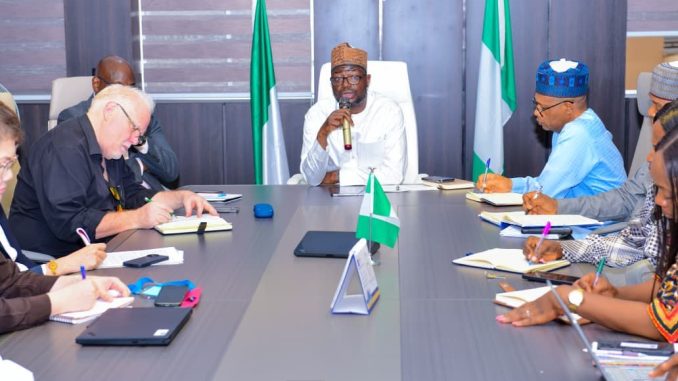
Nigeria’s humanitarian and social protection landscape received a significant boost yesterday as the Honourable Minister of Humanitarian Affairs and Poverty Reduction, Dr. Bernard Mohammed Doro, hosted a succession of high-level delegations from the World Bank, the International Committee of the Red Cross (ICRC) and the Social Protection Development Partners Group (SP-DPG).
Our correspondent reports that the meetings, held in Abuja, underscored increasing global confidence in the direction President Bola Ahmed Tinubu has set for the sector under the Renewed Hope Agenda.
The day opened with the World Bank, led by West Africa Practice Manager Mr. Robert Chase, who commended the administration’s decisive steps toward building a transparent, data-driven social protection system.
Dr. Doro emphasised that the National Social Register; now covering nearly 20 million households; is being upgraded to serve as a credible nationwide gateway for identifying and delivering support to vulnerable Nigerians.
He noted that President Tinubu’s financial reforms have strengthened the fiscal position of state governments, enabling them to play a larger, more effective role in humanitarian and poverty-reduction programmes.
The World Bank team welcomed the Ministry’s forthcoming Strategic Partnership Framework, describing it as a game-changing move to harmonise federal, state, partner and civil society action.
In a follow-up engagement, the Minister received the ICRC delegation led by Doris El Doueihy, who reaffirmed the organisation’s commitment to supporting Nigeria’s conflict-affected communities in the North-East.
The ICRC briefed the Minister on ongoing humanitarian operations, including health and nutrition support, water and sanitation services and protection for vulnerable groups; and praised the government’s strengthened coordination role. Tonter noted Nigeria’s progress in the domestication of the Kampala Convention and welcomed the Ministry’s leadership in addressing the long-standing challenge of more than 24,000 missing persons.
Dr. Doro assured the delegation that under President Tinubu’s direction, Nigeria is entering a new phase of proactive, accountable and people-centred humanitarian governance.
The day concluded with a joint session with the Social Protection Development Partners Group, comprising the EU, UNICEF, Germany, WFP, UNDP, the US Government, Action Against Hunger, ILO and others.
Partners delivered updates on large-scale interventions supporting cash transfers, food security, livelihoods, data systems and social safety nets in multiple states.
They expressed strong alignment with the government’s push for better coordination, sustainable financing and unified programme monitoring. Many described the emerging reforms as some of the most promising steps Nigeria has taken in more than a decade.
Dr. Doro reiterated the Ministry’s commitment to building a seamless national humanitarian and social protection architecture driven by data, collaboration and accountability. He highlighted President Tinubu’s focus on innovative green-economy solutions—such as clean cooking, carbon credits and tree-planting; as new pathways for both poverty reduction and private-sector participation. He also announced plans for a national Social Protection, Poverty Reduction, Humanitarian and Peacebuilding Summit early next year.
As the delegations departed, the message was unanimous: Nigeria is resetting its humanitarian and social protection systems with renewed clarity, purpose and global support. Under the Renewed Hope Agenda, and with Dr. Doro steering reform with energy and competence, partners expressed confidence that Nigeria is moving steadily toward a more secure, resilient and inclusive future for its most vulnerable citizens.