
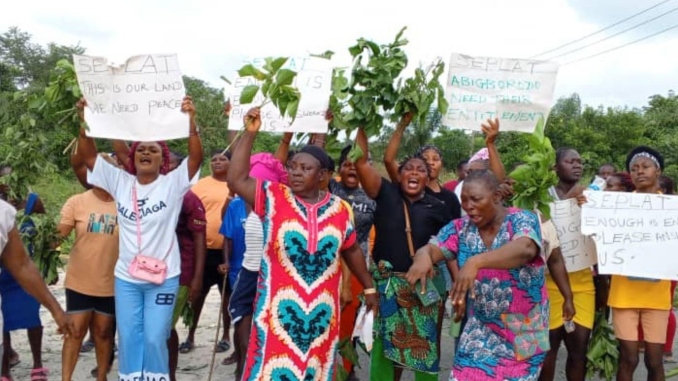
Abigborodo community women in Warri North Local Government Area of Delta State on Monday protested to Seplat Energy company project site to demand recognition as a host community under the Petroleum Industry Act (PIA).
The protesting women numbering over 100, SaharaReporters gathered, stormed the company site as early as 8am armed with placards bearing different descriptions such as “You must recognise us as a host community,” “This is our land and not yours,”, “You will have to kill us over our land.” among others.
Speaking with SaharaReporters, one of the leaders of the women who identified herself as Patient Ologho, described the company as “inhumane” adding that “They have refused to recognise us as host community and we will continue to protest. Our children and our fathers and brothers have no jobs, and we are hungry. They have refused to recognise us.”
Another women leader who identified herself as Felicia Koma, lamented the way and manner the company has allegedly treated them as a company and called on the Delta State government to intervene before everything gets out of hand.
She said, “We cannot continue like this. We are suffering, and Seplat pretends we don’t exist. The government must step in now.”
Another protester, who identified herself as Oyibodudun Ajemijereoma warned the company saying “We are not begging Seplat for favour. We are demanding our rights as host community under the law. If they want peace, they must recognise us,” she said.
According to one of the protesters who did not want her name in print, “The commencement of pipeline operations without resolving earlier disputes leaves much to be desired and such actions risk fuelling communal crises and social unrest in the Niger Delta.
“Several government reports, including the Delta State Judicial Commission of Inquiry into the Okpe Sobo Forest Reserve, published in gazette no. 1 of 2021, affirmed Abigborodo’s ownership of the lands. The state government has failed to act on the white paper arising from that inquiry, which called for recognition and compensation of our people.”
SaharaReporters observed that the protest gathered momentum, as more women and youths were seen joining protest and chanting solidarity songs.
Men were also sighted on the other side of the site joining the protest in solidarity to the women.
Abigborodo and neighbouring Obotie communities had in 2024 embarked in a similar protest against the company, accusing Seplat of encroaching on their ancestral lands, an allgedtion, Seplat Energy had denied.
Abigborodo leaders had in 2023 petitioned the Delta State government, insisting that Seplat’s refusal to recognise them violated provisions of the Petroleum Industry Act, which mandates benefits for host communities.
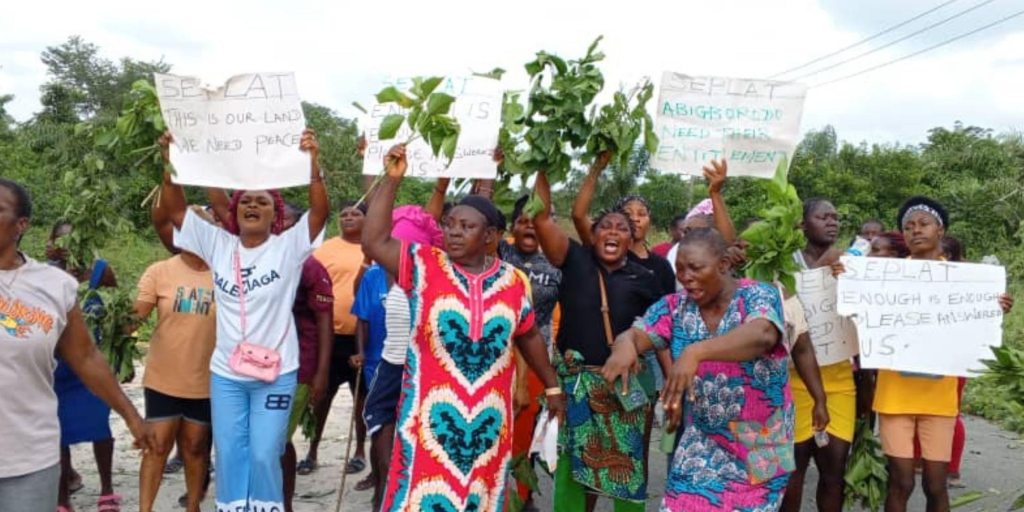
They recalled that the Petroleum Industry Act of 2021 and the Host Communities Development Regulations of 2022 clearly spell out the obligations of oil companies to engage host communities. Yet, they said, Seplat has ignored these provisions, leaving the people sidelined.
As at press time, all efforts to speak with the management of Seplat Energy proved abortive as none was available to comment.