
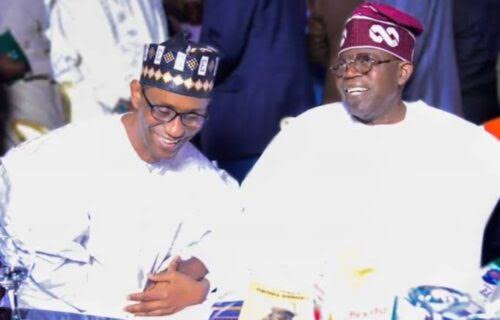
NSA Ribadu: President Tinubu’s Right-Hand Sentinel
A Public Affairs and Security Risk Analyst, Dr. Maxwell Olarotimi has reacted to the controversy surrounding a viral video online where the NSA was spotted alongside other delegates who accompanied President Tinubu on a bilateral visit to the United Kingdom.
Dr. Maxwell in a post stated that the NSA accompanying his principal on a bilateral visit is not out of place.
Read full excerpt:
A grainy video has dominated Nigerian social media this week: National Security Adviser Mallam Nuhu Ribadu and Minister of Arts, Culture and the Creative Economy, Hon. Hannatu Musawa, waving from an open-top carriage as President Bola Ahmed Tinubu’s motorcade glides through the grounds of Windsor Castle. The images, captured during the historic two-day state visit to the United Kingdom (18–19 March 2026), were never meant to provoke. Yet they have become the latest lightning rod for outrage.
Just days earlier, on 16 March, three suspected suicide bombings tore through Maiduguri, Borno State, hitting a post office, Monday Market and the entrance to the University of Maiduguri Teaching Hospital during iftar. At least 23 people were killed and more than 100 injured. In a country exhausted by insecurity, the optics were devastating.
The loudest calls for Ribadu to “stay home and fight terrorists instead of riding in royal carriages” have not come from ordinary citizens. They stem overwhelmingly from sponsored pundits and opposition politicians, particularly from the northern part of Nigeria who see the NSA as a clear threat to their own political ambitions ahead of 2027. The timing and coordination of the attacks suggest a calculated effort to damage a man whose rising profile and quiet competence unsettle long-standing power calculations.
The emotion they are trying to stoke is understandable. The facts they are distorting are not.
In the complex theatre of global diplomacy, where threats like terrorism, banditry and transnational crime know no borders, the presence of Nigeria’s National Security Adviser alongside President Bola Ahmed Tinubu on every major bilateral and state visit is not a luxury, it is a strategic necessity. As the President’s principal adviser on all matters of national security, Mallam Nuhu Ribadu serves as the indispensable bridge between Abuja’s domestic priorities and the international partnerships essential to dismantling insurgent networks.
Far from a ceremonial passenger, Ribadu is President Tinubu’s right-hand sentinel. In high-level engagements like the UK trip, Nigeria’s first full state visit to Britain in 37 years, hosted personally by King Charles III and Queen Camilla, he is central to the substance. Security cooperation, intelligence-sharing protocols, counter-terrorism partnerships, defence diplomacy and joint operations frameworks are woven into every discussion. These are not distractions from domestic threats; they are force multipliers in the fight against them.
The Office of the National Security Adviser (ONSA) is constitutionally positioned as the apex coordinator of Nigeria’s entire security architecture. It is an intelligence and coordination body, not an operational fighting force. It has no soldiers, no battalions, no rapid-response units under its direct command. Its mandate is clear: gather, analyse and disseminate intelligence to the agencies that execute, the Armed Forces, Nigeria Police Force, Department of State Services and others. The NSA advises the President directly, chairs meetings of intelligence agencies, oversees the National Counter-Terrorism Centre, and ensures actionable intelligence reaches those who can act on it.
When Boko Haram, ISWAP or bandits strike, the ONSA’s job is complete the moment intelligence is shared. Execution rests with the operational agencies. Yet the pattern is now familiar: whenever tragedy strikes, the ONSA and Nuhu Ribadu are singled out for withering criticism, while the agencies responsible for turning intelligence into action are left untouched. Political opponents rarely name the service chiefs, police leadership or field commanders. The heat is reserved almost exclusively for the man whose office exists to advise and coordinate, not to storm hideouts.
Service chiefs are warriors, not diplomats. Their solemn responsibility is to remain at the frontlines or in Defence Headquarters, refining tactics, deploying troops and translating high-level international gains into battlefield victories, rather than engaging in turf wars or bureaucratic delays. As a matter of fact, all the service chiefs in command of troops IG, DSS DG, COAS, CAS, CNS and CDS are in the country, in fact some are in the North East commanding troops. President Tinubu himself has repeatedly hailed Ribadu’s leadership, declaring during a visit to Yola in February 2026, “I’m proud of you, Ribadu. We are grateful for your commitment to liberate Nigeria from banditry and insurgency.”
The Windsor video and the manufactured outrage miss the bigger picture. Ribadu’s advisory input has repeatedly delivered strategic security gains across President Tinubu’s bilateral itinerary. Consider these five high-level engagements where his role was pivotal:
- United Kingdom (March 2026): Ribadu stood at the President’s side during talks with Prime Minister Keir Starmer and King Charles III, embedding deeper intelligence cooperation, counter-terrorism pacts, advanced training and joint operations frameworks — directly strengthening Nigeria’s toolkit against Northeast and Northwest threats.
- France (June 2023 inaugural trip and November–December 2024 state visit): Ribadu secured pledges of technical support, counter-terrorism training and intelligence cooperation to stabilise the Sahel and contain spillover threats from Boko Haram affiliates, while integrating security dimensions into infrastructure and agricultural pacts.
- China (August–September 2024): Ribadu’s briefings elevated the strategic partnership to include enhanced intelligence and cyber-security cooperation against transnational threats.
- Türkiye (January–February 2026): Accompanying Tinubu for the signing of nine major agreements (valued at up to $5 billion), Ribadu drove the security and military cooperation components, covering training, equipment and joint operations frameworks.
- United States (high-level engagements and Pentagon talks in November 2025): Ribadu personally led the Nigeria-US Joint Working Group on counter-terrorism, navigating sensitive discussions on intelligence sharing, civilian protection and religious freedom. The outcome was swift and tangible: enhanced coordination with US AFRICOM produced US airstrikes in December 2025 that neutralised key ISIS terrorists, destroyed logistics hubs and disrupted networks in Sokoto and other theatres. Ribadu himself highlighted these “tangible operational gains” at the Group’s inauguration in Abuja in January 2026.
In each case, Ribadu was not sightseeing. He was advising the President on how to translate diplomatic access into concrete security multipliers that benefit Nigerians back home.
International engagements like the UK visit are not holidays; they are strategic investments. The bilateral talks in London will deepen intelligence cooperation, training programmes, equipment support and joint frameworks against the very terrorists who struck Maiduguri. Ribadu’s presence ensures Nigeria’s priorities are embedded in binding agreements with capable partners the UK, US, France, Türkiye and others.
President Tinubu did not leave the country unsecured. Standard protocols keep command structures operational at home. But the strategic value of the NSA accompanying the President has been proven repeatedly. Through Ribadu’s tireless coordination, these visits have forged a global coalition: real-time intelligence pipelines, professionalised forces, equipped troops and diplomatic isolation of insurgents. The result? Strengthened synergy among Nigeria’s security agencies, unprecedented joint operations and frontline successes that President Tinubu has publicly attributed to Ribadu’s commitment.
Nigerians have every right to demand results on insecurity. The pain of Maiduguri’s latest losses is raw and real. But allowing a small clique of sponsored voices to turn a state visit into a morality play about one man waving in a carriage solves nothing. It feeds a familiar, selective script: blame the NSA, ignore the broader architecture, repeat.
Insecurity is transnational. Boko Haram and ISWAP draw inspiration, funding and fighters from beyond our borders. Only the NSA, embedded at the President’s side, can secure the partnerships that starve them of oxygen. Mallam Nuhu Ribadu has not only defined the role for this era, he has delivered results that position Nigeria to tackle insecurity head-on.
The carriage may have looked glamorous on video. The real work of national security happens in the quiet briefings, shared databases and strengthened partnerships that these visits quietly secure. Dismissing that reality does not make Nigeria safer. It only makes the search for solutions harder.