
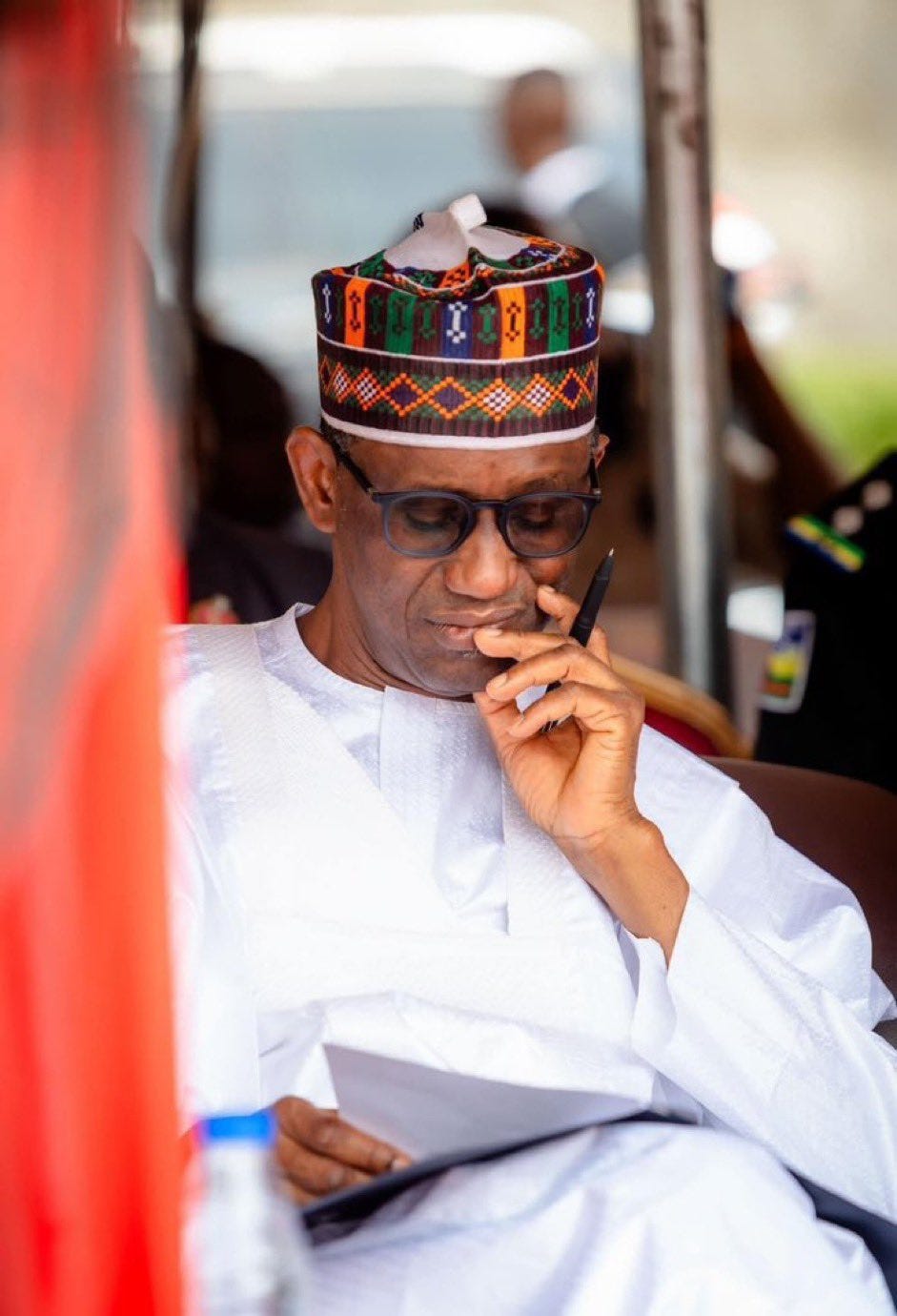
In the relentless fight against terrorism, banditry, and criminality that has plagued Nigeria for over a decade, few figures embody the fusion of institutional memory, prosecutorial rigor, and operational grit quite like Mallam Nuhu Ribadu, the National Security Adviser to President Bola Ahmed Tinubu.
A retired police officer, seasoned prosecutor, and pioneer Chairman of the Economic and Financial Crimes Commission (EFCC), Ribadu brings to the Office of the National Security Adviser (ONSA) a unique pedigree forged in the trenches of law enforcement and anti-corruption battles.
His career trajectory, from Divisional Crime Officer in Lagos to head of the Police Legal and Prosecution Department, and then to dismantling high-profile financial crime networks at the EFCC, has equipped him with an unparalleled understanding of how criminal enterprises sustain themselves through intricate logistics, illicit financing, and shadowy supply chains. Today, that expertise is being deployed not against white-collar fraud, but against the lifeblood of insurgents: their ability to move men, materiel, and money.
Under Ribadu’s stewardship, the ONSA has transformed into a nerve center for intelligence fusion and inter-agency coordination. Rather than operating in silos, Nigeria’s security architecture, military, police, Department of State Services (DSS), National Drug Law Enforcement Agency (NDLEA), and Civilian Joint Task Forces (CJTF) now benefits from real-time, actionable intelligence emanating from the NSA’s office. This intelligence-driven doctrine, rooted in Ribadu’s investigator’s mindset, prioritizes “logistics strangulation”: denying terrorists and bandits the fuel, ammunition, food, medical supplies, and precursor chemicals that keep their operations alive. The results, particularly over the past six months (October 2025 to April 2026), speak for themselves in a cascade of precision strikes, ambushes, arrests, and interceptions that have delivered devastating blows to ISWAP, Boko Haram, armed bandits, and affiliated criminal networks.
The most emblematic operation came in the night of 21/22 April 2026, when troops of the Joint Task Force (North East) Operation HADIN KAI (OPHK) unleashed devastating precision air strikes on ISWAP’s waterway logistics network along the Lake Chad axis near Kaniram Island in Northern Borno State. Acting on credible Intelligence, Surveillance and Reconnaissance (ISR) inputs coordinated through ONSA channels, air assets established persistent overhead presence over more than 30 terrorist boats engaged in movement and resupply. High-fidelity targeting ensured minimal collateral damage while dismantling a critical resupply artery. Scores of terrorists were neutralized, and the insurgents’ ability to ferry fighters, weapons, and provisions across the lake was crippled.
This was no isolated tactical success; it was the culmination of sustained intelligence-sharing that has redefined counter-insurgency in the theatre.
The past six months have witnessed an unrelenting sweep against Boko Haram and ISWAP logistics networks. In April 2026 alone, troops arrested 53 suspected terrorist logisticians, couriers, and informants in a single week as part of intensified “logistics strangulation” operations.
Twelve additional suspects were picked up at Gubio Market in an intelligence-driven operation, bringing the weekly total to 53. A Boko Haram logistics convoy of 13 persons was intercepted at a checkpoint in Kanama, Borno, with two gunshot victims linked to an earlier ambush while transporting supplies. Three women, Falmata Abukar (43), Halima Audu (35), and Mairo Abba (17) were arrested in Monguno while attempting to move supplies to terrorist elements. In Mainok, Kaga LGA, troops intercepted abandoned logistics items including fabrics, clothing materials, powdered milk, beverages, and provisions clearly destined for camps. Night ambushes neutralized three logistics suppliers near Geidam market, recovering a Toyota Hilux and smartphones with terrorist videos; eight more were neutralized in Bama.
Earlier actions in October 2025 saw four ISWAP logistics suppliers killed in coordinated ambushes in Konduga; two suppliers were arrested with provisions and drugs on the Ngamdu–Goniri road; and a major cache, blankets, engine oils, welding materials, tricycle rims, and a grinding machine—was uncovered along the Damasak–Kareto road.
Fuel suppliers were arrested, and medical supplies concealed in cement bags were intercepted in Yobe. Each operation traced back to shared intelligence that allowed proactive interdiction.
These strikes have not been confined to the North-East. Bandit and kidnapper supply chains have been systematically dismantled nationwide. In September 2025, military and police arrested a syndicate in Abuja supplying weapons to bandits linked to the Yelwata massacre in Benue and kidnappings in the FCT, recovering AK-47s, ammunition, and motorcycles. Arms and drug networks feeding bandits in Kaduna, Katsina, Zamfara, and Sokoto were busted, with fabricators and codeine/tramadol suppliers neutralized.
In October 2025, 88 suspects, including terrorist collaborators and logistics suppliers were arrested nationwide, alongside the rescue of 26 kidnapped victims. Ammonium sulphate (a bomb-making precursor) in excess of 800 bags was intercepted in Bauchi under Operation Enduring Peace. IPOB/ESN arms pipelines were severed when 164,650 live cartridges hidden in a truck from Ghana were seized on the Anambra/Asaba–Onitsha axis.
NDLEA operations, often in synergy with the military, intercepted massive consignments of cannabis, cocaine in food flasks, and tramadol destined for armed groups.
The Nigerian Army’s latest situational update underscores the momentum: ambushes near Kuranabassa in Gwoza forced ISWAP/JAS fighters to retreat; three vehicles conveying solar panels, water pumps, construction materials, phones, and cash were intercepted on the Yunusari–Bukarti axis; ammunition and magazines were recovered in Kogi; clearance operations destroyed bandit hideouts in Katsina; 12 civilians were rescued in Plateau; illegal petroleum products were secured in Rivers; and nine informants linked to a criminal kingpin were arrested in Taraba. These are not random successes but the direct outcome of ONSA-coordinated intelligence enabling seamless joint operations across theatres.
Ribadu deserves unequivocal commendation for this excellence. His background as a hands-on investigator, prosecuting cases that once seemed untouchable, has instilled a culture of precision, accountability, and inter-agency trust that was previously elusive.
By insisting on intelligence primacy over reactive firefights, he has shifted the paradigm from attrition to asphyxiation of terrorist lifelines. The human cost of insurgency, lives lost, communities displaced, economies shattered, has been measurably reduced. Yet the work is far from complete. Residual threats persist in forests, waterways, and border corridors. Ribadu must remain laser-focused, doubling down on technology-enabled ISR, community intelligence networks, and cross-border partnerships to achieve the overarching goal: a Nigeria finally rid of terrorism and armed banditry.
The tide is turning not through rhetoric, but through relentless, intelligence-driven execution. Nigerians owe a debt of gratitude to Mallam Nuhu Ribadu and the men and women executing these operations. With sustained focus, the day when supply chains to evil are permanently severed and peace returns to every corner of the federation is within reach.
Ejike Mbonu is a Security Strategist and writes from Kaduna