
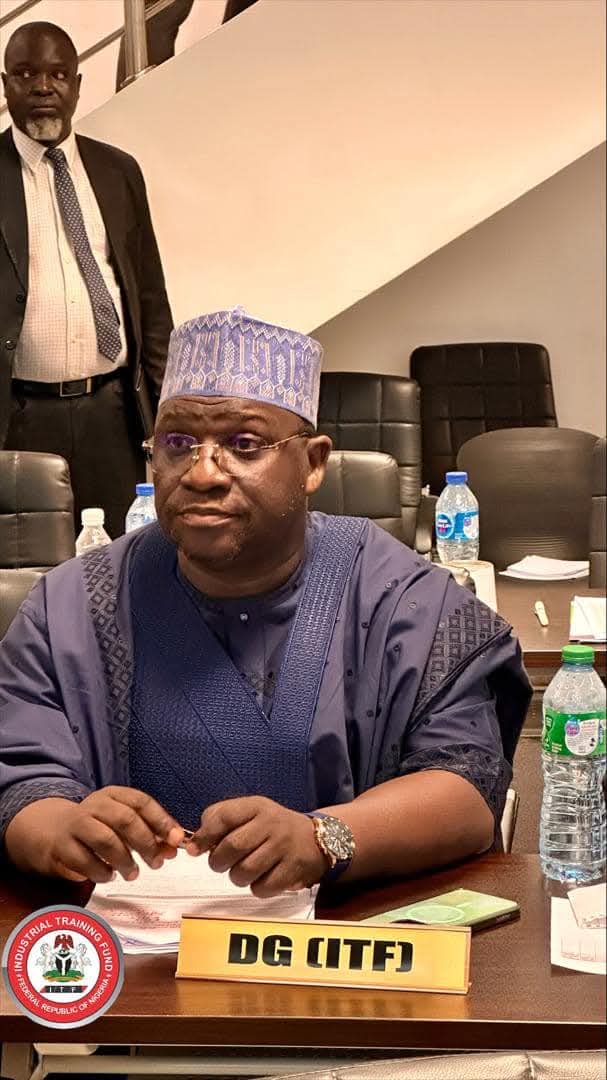
Afiz Ogun- The man reshaping ITF through skills, innovation and empowerment
By Golok Nanmwa, Jos
When President Bola Ahmed Tinubu appointed Dr Afiz Oluwatoyin Ogun as Director-General and Chief Executive Officer of the Industrial Training Fund, ITF, in October 2023, he entrusted him with the leadership of one of Nigeria’s key institutions for human-capital development.
Nearly three years into his tenure, Ogun’s leadership of the Fund has become increasingly associated with an ambitious approach to skills development that goes beyond conventional training to embrace professional certification, entrepreneurship, business incubation, international standards, technology, innovation and institutional development.
At the heart of this new direction is the Skill-Up Artisans, SUPA, Programme, which has placed Nigerian artisans at the centre of the ITF’s skills-development agenda.
SUPA- Putting artisans at the centre
SUPA has emerged as one of the signature initiatives under Ogun’s leadership at the ITF.
The programme is designed to identify practising and intending artisans, assess their competencies, provide additional training, certify them and create pathways to employment, entrepreneurship and opportunities in local and international markets.
Its foundation phase produced 29,000 artisans in 2024, while the subsequent phase targeted an additional 100,000 beneficiaries.
The Fund also moved to expand its network of private training centres from about 880 to 1,500.
The significance of SUPA lies in its attempt to formalise Nigeria’s huge informal skills sector, where millions of skilled workers acquire expertise through apprenticeship but often lack recognised professional certification.
Under Ogun, the emphasis has increasingly shifted from merely counting the number of people trained to focusing on what those skills ultimately mean for beneficiaries, their businesses and the wider economy.
From training to certification and enterprise
One of the notable features of the new approach is the stronger emphasis on professional certification rather than simply distributing starter packs.
The philosophy is straightforward: skills acquisition should lead to recognised qualifications, employment, entrepreneurship, productivity and improved access to economic opportunities.
In 2026, the ITF deepened this approach by commencing nationwide screening for another batch of SUPA beneficiaries, targeting 200,000 artisans in the first phase.
The screening was designed to ensure that genuine artisans benefited from the programme, while a N3.6 billion Business Incubation Programme was announced to provide equipment for successful beneficiaries.
The business-incubation component is particularly significant because it seeks to bridge the gap between acquiring a skill and building a sustainable enterprise.
Building a credible artisan workforce
Ogun has also placed emphasis on ensuring that the Fund’s interventions reach genuine practitioners.
At a September 2026 engagement with artisans from the 36 states and the Federal Capital Territory under the Nigeria Artisans for the Renewed Hope Initiative, NARHI, he disclosed that some applicants claiming to be artisans lacked basic knowledge of their trades.
The development prompted the ITF to strengthen its screening process and direct its area offices to work with recognised artisans’ associations to ensure that genuine practitioners benefit from the programme.
The Fund has also established the Skills House in Abuja, which Ogun has described as a home for skills where artisans can seek solutions to challenges confronting their trades.
Taking Nigerian skills to the world
Another major dimension of Ogun’s leadership is the drive to raise Nigerian technical manpower to international standards.
In August 2026, the ITF commenced an eight-week training programme for 100 artisans and trainers with the participation of experts from the United Kingdom.
The programme is designed to strengthen technical, teaching and assessment competencies, creating a pool of skilled trainers capable of transferring internationally benchmarked knowledge to other Nigerian workers.
Areas covered include floor tiling, bricklaying, carpentry, painting and decorating.
The larger objective is to produce Nigerian artisans whose skills can compete internationally while reducing the country’s dependence on foreign technical manpower.
Transforming the Bukuru skills centre
In Plateau State, the ITF Centre for Excellence and Model Skills Academy along the Jos-Bukuru Expressway have also become important components of Ogun’s skills-development vision.
Under his leadership, the facilities have witnessed significant investment through strategic public-private partnerships, culminating in the installation of modern vocational equipment at the Model Skills Academy.
A major highlight has been the formal launch and equipping of the ITF Model Skills Academy in Jos, which features specialised departments for culinary arts and bakery and pastries, industrial garment production, automated monogramming and commercial textile knitting.
The academy has been equipped with mobile stainless-steel workstations, e-learning systems, commercial ovens, extractors, high-capacity industrial knitting machines and other industry-grade equipment installed over a 13-month period.
The investment is designed to provide young Nigerians with practical, industry-relevant skills while supporting the broader objectives of SUPA and the Federal Government’s human-capital development agenda.
Dual education- Combining classroom learning with practical skills
Another innovation at the Jos facility is the introduction of the Dual Education System, also known as the Dual Learning Programme, for students of the ITF Model School.
Under the programme, regular academic classes end at 1:30 p.m., after which students are transported by bus to the skills academy for practical vocational training.
The students receive two hours of practical training on weekdays and three hours on weekends and holidays.
The initial focus is on Junior Secondary School One and Senior Secondary School One students, with plans for the model to be replicated across Nigeria’s six geopolitical zones.
Training areas include fashion design and tailoring, monogramming and embroidery, culinary arts, welding, including manual and laser welding, as well as information and communication technology, including artificial intelligence programming and cybersecurity.
Upon completion of the two-year programme, participants are expected to sit for internationally recognised examinations, including City & Guilds qualifications, providing opportunities for certification and employment in Nigeria and abroad.
Exceptional trainees can also benefit from business-incubation support.
From vocational training to digital technology
Ogun’s vision for the ITF has equally extended into emerging technologies.
The Fund has established a Digital Fabrication Centre in Lagos, while the Enugu State Government in August 2026 approved land for another ITF Digital Fabrication Centre.
The centres are expected to promote local manufacturing, innovation and employment while exposing Nigerians to emerging technologies such as artificial intelligence, robotics and computer-aided manufacturing.
The expansion reflects an effort to ensure that Nigeria’s technical and vocational training keeps pace with changes in the global economy.
Beyond SUPA
SUPA is only one component of the wider intervention programmes being implemented by the ITF.
The Fund continues to undertake skills-development initiatives covering industrial skills, women empowerment, construction, agripreneurship and training for persons with disabilities.
In 2024, the ITF reported that more than 29,000 Nigerians had been trained and empowered through its various skills-intervention programmes.
The Abeokuta Area Office was also recognised as the overall best-performing area office in the Fund’s 2024 assessment.
The interventions cover practical areas including welding, electrical installation, tiling, carpentry, agriculture and other vocational trades.
Taking skills to the grassroots
Ogun has also personally inspected SUPA training centres in Jos and other parts of Plateau State, with emphasis on quality assurance, effective monitoring and ensuring that beneficiaries receive the required support.
During such engagements, trainers were encouraged to use local languages and Pidgin English where necessary to improve comprehension among trainees while maintaining the required training standards.
The ITF has also screened thousands of Plateau artisans, including a major exercise involving about 15,000 applicants, for placement into relevant trades under SUPA.
The approach demonstrates the administration’s emphasis on taking skills development closer to the people and ensuring that programmes are designed around the realities of beneficiaries.
A stronger institution
Ogun’s focus has not been limited to beneficiaries. Institutional performance has also received considerable attention.
Presenting the ITF’s 2024 corporate scorecard, the DG described the year as the Fund’s best financial year since inception, with the organisation exceeding its revenue targets and recording its highest revenue performance.
The broader legacy of the ITF is also significant.
Marking the Fund’s 45th anniversary in 2025, Ogun said the organisation had trained and empowered more than 25 million Nigerians in various skills since its establishment.
The figure represents the cumulative contribution of the ITF over decades, but Ogun’s administration is building on that legacy with a stronger focus on certification, entrepreneurship, technology and global competitiveness.
Infrastructure and staff welfare
Ogun’s administration has equally paid attention to infrastructure and staff welfare.
In August 2026, the ITF commissioned a 47,600-litre-capacity fuel station at its headquarters in Jos.
The facility was constructed on a 2,150-square-metre site previously used as a fuel dump for ITF vehicles.
The project, awarded in May 2025 and completed in March 2026, is expected to improve fuel access and support operational efficiency.
Staff can purchase fuel using their identification cards, with payment deducted from their salaries.
Modupe Ogun: Strengthening the teachers behind the children
The human-capital development vision associated with the Ogun family has also extended into education.
Mrs Modupe Afiz Ogun, wife of the ITF Director-General, through the Modupe Afiz Ogun Foundation, has focused attention on children with learning, intellectual and developmental disabilities and the teachers responsible for supporting them.
In September 2026, the Foundation organised a three-day Teachers’ Professional Development Training for staff of the ITF Model School, Jos.
The programme focused on equipping teachers to identify and support learners with specific learning disabilities and other learning challenges.
Mrs Ogun emphasised the importance of early identification and sustained support, reinforcing the message that every child can learn, although different children may require different approaches.
The man behind the numbers
For Ogun, the ITF story is therefore bigger than statistics.
It is about connecting skills to productivity, certification to opportunity, artisans to industry, education to practical knowledge and training to enterprise.
From SUPA and international certification to business incubation, digital fabrication, the transformation of the Bukuru skills centre, the Dual Education System, institutional development and staff welfare, the direction of the ITF under his leadership reflects a deliberate effort to make skills more relevant to the realities of Nigeria’s economy.
Nearly three years after assuming office, Ogun has placed skills development firmly at the centre of his administration.
His leadership has brought together artisan development, vocational education, technology, entrepreneurship, global certification and institutional renewal in an increasingly integrated skills-development agenda.
For an institution created to develop the nation’s workforce, the emerging story of the ITF under Dr Afiz Oluwatoyin Ogun is one of renewed purpose , training people, certifying skills, supporting enterprise, empowering young Nigerians and preparing the Nigerian workforce for a changing world.