
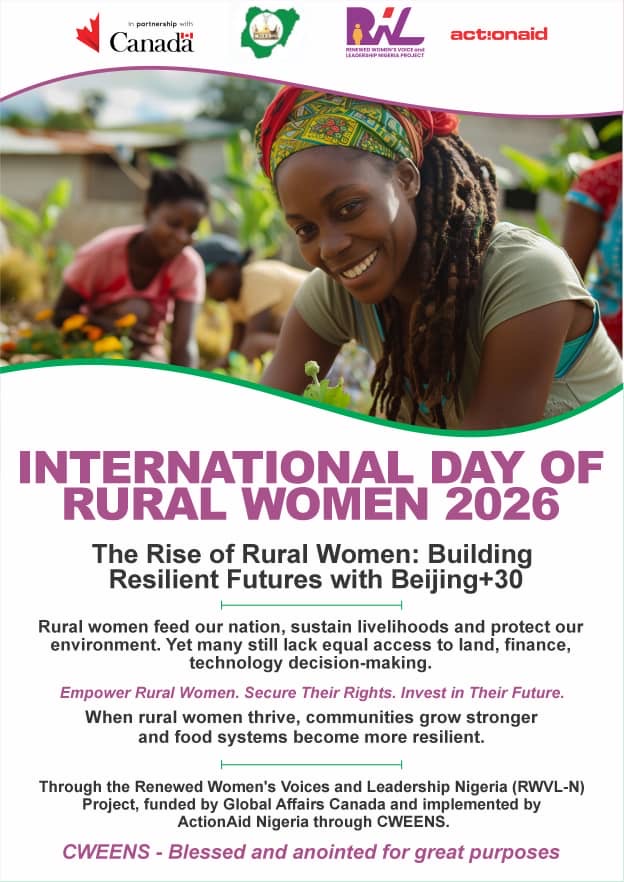
A Feature Story by the Communications Department, CWEENS Nigeria
International Day of Rural Women | 15 October 2026
Rural women are among the quiet forces sustaining Nigeria’s food systems. From cultivating crops and preserving seeds to processing produce, managing household food supplies and supporting local markets, their work helps feed families, sustain livelihoods and keep communities going.
Yet, behind their enormous contribution lies a persistent inequality: many rural women who help produce the nation’s food continue to face barriers to the resources, financial opportunities and decision-making power they need to thrive.
This year’s International Day of Rural Women, observed on 15 October, is marked under the United Nations theme, “Rural Women Farmers Caring for Mother Nature.”
The theme recognises rural women’s roles in conserving seeds, protecting biodiversity, managing water and restoring degraded land, while calling attention to the need to strengthen their rights, resources and leadership in building a more resilient future.
For Christian Women for Excellence and Empowerment in Nigerian Society (CWEENS), the observance is an opportunity to celebrate rural women not only as food producers and environmental stewards, but also as entrepreneurs, community leaders and agents of economic change.
The Cost of Leaving Women Farmers Behind
The case for investing in rural women is both a matter of fairness and an economic necessity.
According to a report published by THISDAY, citing the Food and Agriculture Organization of the United Nations (FAO), Nigeria loses an estimated US$2.3 billion annually—about two per cent of its Gross Domestic Product—to gender gaps in agricultural productivity.
The report highlights unequal access to land, finance, technology, agricultural services and markets as major barriers limiting women farmers’ productivity and economic participation.
Read the report:
https://www.thisdaylive.com/2026/09/16/womens-farming-gap-costs-nigeria-2-3bn-yearly-fao-warns/
Globally, women account for close to 40 per cent of the agricultural labour force, yet they own only about 15 per cent of agricultural land. The United Nations notes that if women had the same access to productive resources as men, farm yields could increase by 20–30 per cent, potentially feeding an additional 100 to 150 million people.
Source: United Nations
https://www.un.org/observances/rural-women-day
These figures point to a fundamental truth: the challenge is not a lack of ability among women farmers. It is the unequal distribution of opportunities and resources that limits what they can achieve.
When women cannot readily access credit, improved agricultural inputs, appropriate technology, profitable markets or secure land rights, their capacity to expand production, strengthen their businesses and withstand economic or climate-related shocks is constrained.
Their labour remains essential, but their economic power often does not reflect their contribution.
Closing this gap requires more than celebrating women’s work. It demands sustained investment, fairer access to resources and meaningful participation by women in decisions that affect their livelihoods and communities.
From Saving Together to Building Stronger Livelihoods
At CWEENS, economic empowerment is an important part of the work to strengthen women’s agency, resilience and opportunities for sustainable livelihoods.
Through the Renewed Women’s Voice and Leadership Nigeria (RWVL-N) Project, with support from implementing partner ActionAid Nigeria and funding from Global Affairs Canada, CWEENS is advancing Village Savings and Loan Associations (VSLA) as part of its approach to strengthening women’s economic participation.
VSLA provides a community-based structure through which members save collectively, access loans under agreed group arrangements, build financial knowledge and develop habits of accountability and mutual support.
For rural women, these structures can help strengthen their capacity to plan, respond to financial needs and explore livelihood opportunities.
But the value of VSLA extends beyond the act of saving. It creates space for women to organise, learn from one another, make collective decisions and build confidence in managing financial resources.
For women farmers and rural women engaged in trading, processing or other livelihood activities, stronger savings and financial-management structures can contribute to a more secure foundation for economic participation.
Their impact, however, depends on how well the groups are supported, the opportunities available to members and the connections they can build with markets and other financial services.
CWEENS’ VSLA work is therefore part of a wider effort to strengthen pathways to economic resilience for women and girls, including women rebuilding their livelihoods following difficult experiences and reintegration.
Building Beyond Savings: From Groups to Opportunities
The journey towards sustainable economic empowerment does not end with establishing savings groups. Women also need opportunities to turn their collective strength into viable and resilient livelihoods.
CWEENS’ ongoing preparatory work across Plateau State, the Federal Capital Territory and Nasarawa State is laying foundations for stronger community-based economic structures.
In Jos, community mapping across four clusters is helping identify a foundation for future savings and lending groups. In the FCT, engagement with the Association of Women in Trade and Agriculture (AWITA) has opened a potential pathway towards stronger networks, technical knowledge and economic opportunities.
In Nasarawa State, engagements with Women Economic Groups and women’s faith-based groups are strengthening community relationships and preparing women for participation in VSLA structures.
.
These efforts reflect an important lesson: economic empowerment is more sustainable when women are organised, connected and supported to access opportunities beyond their immediate communities.
The next stage requires strengthening group capacity, promoting financial literacy and transparent governance, exploring viable commodities, assessing market demand and building value-chain connections.
These steps can help women move towards economic activities with clearer prospects for sustainability, rather than investing resources without sufficient understanding of the market.
For rural women farmers, such connections can be particularly important.
.Access to buyers, storage, appropriate technology, agricultural advice and financial services can influence whether their work translates into better incomes and stronger livelihoods.
Women’s Economic Power and Environmental Resilience
The 2026 theme also reminds us that women’s livelihoods cannot be separated from the health of the environment.
Rural women are often closely involved in managing the land, water, crops and natural resources on which families and communities depend. Climate extremes, declining soil quality, biodiversity loss and water stress can disrupt agricultural production and threaten the livelihoods of those who depend on it.
The Food and Agriculture Organization has warned that climate extremes could push more than 132 million people into poverty by 2030 without collective action. Such risks reinforce the need for resilient food systems and greater investment in rural livelihoods.
Read the report by P.M. News:
https://pmnewsnigeria.com/2026/10/12/132m-people-risk-falling-into-poverty-by-2030-over-climate-extremes-fao-warns/
Strengthening women’s economic agency must therefore go hand in hand with supporting sustainable agricultural practices, improving access to climate information and appropriate technologies, and ensuring that women participate in decisions about land, water, biodiversity and climate-related investments.
Women should not be expected to carry the responsibility of protecting natural resources without the rights, resources and institutional support needed to do so.
Their knowledge and leadership must be reflected in agricultural policies, community planning and environmental action.
Recognition Must Lead to Action
As the world marks the International Day of Rural Women during the United Nations’ International Year of the Woman Farmer 2026, CWEENS calls for practical action to match the contributions rural women make every day.
.
This includes strengthening women’s access to land and productive resources; expanding fair and appropriate financial services; improving access to markets, technology and agricultural extension services; recognising and redistributing unpaid care work; and ensuring that rural women have a meaningful voice in decisions that affect their lives.
It also means investing in women-led groups, supporting collective economic initiatives and creating stronger links between savings, livelihood development and market opportunities.
Through its RWVL-N Project and VSLA work, CWEENS remains committed to contributing to pathways that help women and girls strengthen their agency, access opportunities and participate more fully in the economic and social development of their communities.
The message of this year’s observance is clear: rural women are not simply recipients of support.
They are producers, innovators, environmental stewards and leaders whose knowledge and work are indispensable to sustainable development.
When rural women have the resources to strengthen their livelihoods and the power to shape decisions, families become more resilient, communities gain new opportunities and the future of food systems becomes stronger.
This International Day of Rural Women, let recognition become investment, inclusion become opportunity, and women’s contributions be matched by the rights, resources and decision-making power they deserve.
Through the Renewed Women’s Voice and Leadership Nigeria (RWVL-N) Project, with support from ActionAid Nigeria and funding from Global Affairs Canada, CWEENS continues to promote safer environments where every woman and girl can reach her full potential.