
🇳🇬🇳🇬 Olu Fasan | Vanguard| Dec 30, 2024
Bola Tinubu’s 2024 budget, his first as president, was a whopping N28.77 trillion. He dubbed it “Budget of Renewed Hope.” But, as 2024 crawls to an end this week, the hope that Tinubu promised to renew turns out to be a mirage. Rather than experiencing the actualisation of a hope, most Nigerians have witnessed utter despair. In 2024, according to the National Bureau of Statistics (NBS), over 64 percent of Nigerians had to skip meals and go to bed hungry as they couldn’t afford enough food, while the year ended with nearly 100 people dying in desperate stampedes for “palliatives.” The NBS also said Nigerians paid N2.3 trillion in ransoms as widespread kidnappings gripped the country. So, put simply, Tinubu’s 2024 “renewed hope” budget failed Nigerians.
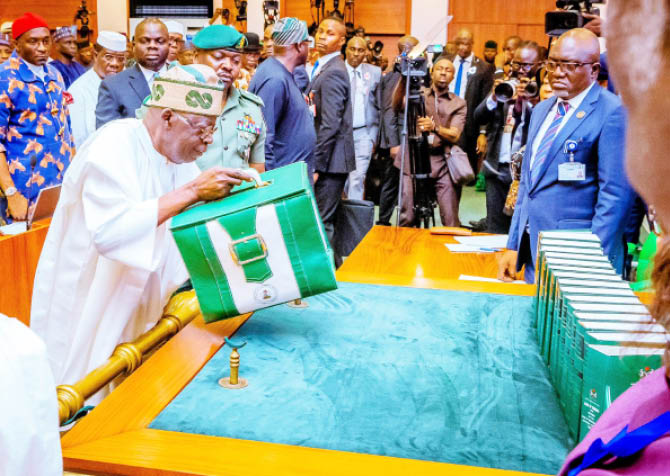
Well, now, Tinubu has proposed a budget of N47.9 trillion for 2025. He calls it “Budget of Restoration: Securing Peace, Rebuilding Prosperity.” But would this staggering sum make an iota of difference to the lives of ordinary Nigerians? The answer, sadly, is no. For truth be told, it’s yet another false hope!
The Yoruba have a saying: “Oju lofiri, ete e o kan.” Roughly translated: you can behold a sumptuous meal, but you won’t taste of it. That’s what government budgets have always meant for ordinary Nigerians: they are not about making people better off. Yet, as Aristotle famously said, politics is “primarily concerned with the actualisation of human flourishing”; and Thomas Jefferson posited, “the care of human life and happiness is the only legitimate object of good government”. Elsewhere, those philosophies underpin government budgets.
Take the UK. The lion’s share of the government’s spending goes on welfare, followed by health, general public services and education. In Nigeria, the government’s budgets are always devoted to the trio of capital expenditure (wasteful spending and misappropriation on “infrastructure”); recurrent expenditure (the cost of funding a bloated bureaucracy); and debt servicing (interest payments on Nigeria’s burgeoning debt). Those three areas of government spending enrich public officeholders and their acolytes, often through corruption, but have absolutely no positive impact on the lives of ordinary Nigerians. Every government should be judged by how it delivers higher living standards for the people; its success should be measured via higher real household disposable incomes. However, Tinubu’s administration fails the Aristotelian or Jeffersonian test of good government: it doesn’t work for the people!
Of course, cocooned in the Aso Rock bubble and echo chamber, Tinubu sees things differently. In his recent Budget Speech, he patted himself on the back unashamedly. “I am happy to inform this National Assembly that our administration attained remarkable milestones in implementing the 2024 Budget,” he said, adding: “I report today that our economy is responding positively to stimulus.” But what are the achievements that Tinubu is trumpeting? Well, he said the economy grew by 3.46 percent in the third quarter 2024, and that “our Foreign Reserves now stand at nearly $42bn, providing a robust buffer against external shocks”. According to the CBN, Nigeria’s external reserves can finance about 9.09months of import of goods and services. That’s what Tinubu describes as “robust buffer against external shocks.” But does Tinubu have a sense of history? Does he know the trajectory of Nigeria’s economy since 1999? If he did, he would know that, at this stage of his presidency, he is Nigeria’s worst president since 1999, and that’s based on facts.
Recently, SBM Intelligence, the superb market/security intelligence gathering and strategic consultancy, produced five brilliant charts tagged “Economic Performance of Nigeria’s Presidents 1999 to 2024.” The charts show data on GDP growth rate, inflation rate, foreign reserves, debt, and exchange rate under Presidents Olusegun Obasanjo, Umaru Yar’ Adua, Goodluck Jonathan, Muhammadu Buhari, and Bola Tinubu. On each of these indicators, Tinubu performed far worse than all the previous presidents, including even Buhari.
The average annual GDP growth rate was about 8 percent under Obasanjo, Yar’ Adua and Jonathan. Yet, Tinubu is celebrating 3.46 percent. Inflation never went beyond 18 percent under any of the previous presidents: now it is 34.6 percent. Foreign reserves were, under Yar’ Adua, $45,394bn (2007), $58, 473bn (2008) and $44,702 (2009); under Jonathan, $45.6bn (2013); and believe it or not, under Buhari, $44, 560bn (2018) and $42, 990bn (2019). So, why is Tinubu gloating about $42bn, as if it’s extraordinary and unprecedented?
Then, take debt. Near the end of their terms, Obasanjo left a debt of N0.45trn in 2006; Yar’ Adua, N0.438trn (2009); Jonathan, N11, 243trn (2014); and Buhari, N44, 064trn (2022). What about Tinubu? Well, in his just 18 months in office, Nigeria’s debt is N134,298trn (2024). What about the exchange rate? It was N142.50 to $1 under Obasanjo (2005); N123.06 under Yar’ Adua (2009); N164.80 under Jonathan (2014), and N428 under Buhari (2022). And under Tinubu? Well, it’s approximately N1,700 to $1. Now, I have reproduced these data, piggybacking on SBM’s sterling work, just to make one point: Tinubu insults people’s intelligence when he brags about his economic “achievements” considering Nigerians’ economic distress and given the economic performance of his predecessors.
Yet, last week, in the so-called Presidential Media Chat, Tinubu asserted the right to brag, saying of his performance, “to me, that’s excellent, I repeat, excellent”. Asked whether he was grading himself, he replied: “Why not?” But shouldn’t Nigerians do so? His answer: “I should grade myself if I do my homework right.” So, Tinubu is self-referential, setting and marking his own exam paper. One area he gave himself a high mark was on security. He said Nigerians could now travel without much fear. But how does that square with the fact that, according to NBS, Nigerians made N2.3 trillion ransom payments from May 2023 to April 2024, under his presidency, with 65 percent of households affected by kidnapping incidents?
The interview was full of contradictions. For instance, on the one hand, Tinubu said Nigeria was spending its future on the fuel subsidy, but, on the other, he said that “borrowing is not criminal” and justified mortgaging the country’s future on debt even if Nigeria has to spend about 35 percent of its budget to service it at the expense of critical areas such as health, education and welfare. Tinubu also defended his bloated cabinet, comparing Nigeria to hosting 100m people at a party and asking, “how many stewards would you need”? Unfortunately, the journalists who interviewed him thought that was funny. They were captivated by his rhetoric and the confidence he exuded, and less concerned about the substance of what he said with his trademark arrogance, insensitivity and indifference.
Sadly, the same hubris is writ large in his 2025 budget. Tinubu said the N47.90 trillion budget “is ambitious, but necessary to secure our future.” But first, the N15.81trn allocated for debt servicing is more than the total amounts allocated for defence and security (N4.91trn); infrastructure (N4.06trn); health (N2.48trn) and education (N3.52trn). Second, N13.08trn of the N47.9trn is a deficit to be funded by borrowing. The rest is based on dubious assumptions on crude production, refined petroleum import and export, exchange rate, inflation rate and investment inflows, ignoring his own fiscal indiscipline and potential global headwinds following Donald Trump’s return as US president. But even if the N47.9trn budget is realistic, who will be its main beneficiaries? Be under no illusion: it won’t be ordinary Nigerians. Yet another false hope awaits them.
Think about it: how many Nigerians did the 2024 budget lift out of poverty or deliver from hunger? Hardly any. Yet, Tinubu says “2025 is a very promising year.” Well, fingers crossed!