
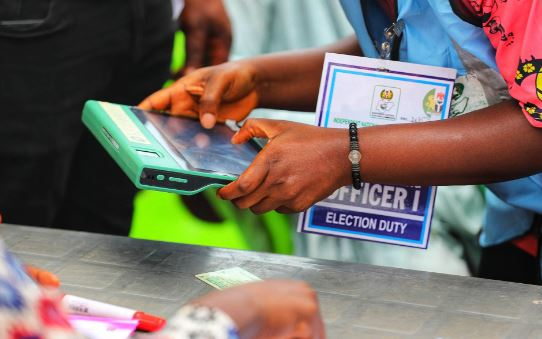
Fresh facts have emerged on how the Senate rejected a proposal to make real-time electronic transmission of election results mandatory, ahead of the 2027 general election.
The proposal formed part of the Electoral Act, 2022 (Repeal and Enactment) Bill, 2026 (SB. 903), specifically an amendment to Clause 60(3), which sought to compel presiding officers of the Independent National Electoral Commission, INEC, to upload polling unit results to the INEC Result Viewing Portal, IReV, in real time.
The recommendation, which also triggered wider reforms on election timelines, penalties for electoral offences and voting technology, was voted down by the 10th Senate under the leadership of Senate President, Senator Godswill Akpabio.
At the centre of the controversy is Section 60(3) of the bill, dealing with the transmission of polling unit results. The provision was recommended by the Senate Committee on Electoral Matters, chaired by Senator Simon Lalong (APC, Plateau South).
Sources told Vanguard that during clause-by-clause consideration of the committee’s report, the Senate initially worked on a version that retained real-time electronic transmission.
However, after hours of deliberations and as plenary dragged late into the evening, the final version passed by the Senate was altered at the last minute to expunge the provision.
This, sources said, was even though the Senate had earlier approved electronic transmission overwhelmingly during a closed session.
An ad-hoc committee, chaired by Senator Niyi Adegbonmire, APC (Ondo Central), had also endorsed it after more than one year of consultations.
The Adegbonmire committee engaged INEC, civil society organisations and stakeholders through joint sessions and zonal public hearings, where consensus was reportedly reached that electronic transmission must be explicitly legalised to avoid the legal controversies that trailed the 2023 general elections.
Page 45 of the report of the Senate Committee on Electoral Matters, Clause 60(3) provided: “The Presiding Officer shall electronically transmit the results from each polling unit to the IREV portal in real time and such transmission shall be done after the prescribed Form EC8A has been signed and stamped by the Presiding Officer and/or countersigned by the candidates or polling agents available at the polling unit.”
A source said that when senators got to the clause, many assumed it would pass smoothly, given prior resolutions.
“That was when the unexpected happened,” the source said, adding that three ranking Southern senators allegedly intervened.
According to the source, the senators approached the Senate President and urged him to retain the provision of the 2022 Electoral Act.
Akpabio was said to have upheld the existing law, which allows electronic transmission only after votes are counted and publicly announced at polling units.
Instead of “transmission,” the word “transfer” was adopted, in line with the 2022 Act, even though no fresh debate was conducted on the floor.
The rejected amendment would have mandated real-time upload of results to IReV immediately after completion of Form EC8A.
The adopted provision states: “The Presiding Officer shall transfer the results, including the total number of accredited voters and the results of the ballot, in a manner as prescribed by the commission.”
Senate bows to pressure, to hold emergency sitting tomorrow, instead of Feb 24
However, following the widespread criticisms that have trailed its rejection of a proposed amendment to Clause 60, Subsection 3, of the bill, which sought to make the real time electronic transmission of election results mandatory, the Senate has been forced to reconvene an emergency plenary sitting tomorrow, February 10, 2026, at 12:00 noon.
It had on Wednesday, adjourned plenary till February 24.
The new development to reconvene tomorrow was formally contained in an official notice dated February 8, 2026, signed by the Clerk of the Senate, Emmanuel Odo, on the directive of the President of the Senate, Senator Godswill Akpabio.
The notice to the senators, sighted yesterday, read: “I am directed by President of the Senate, Distinguished Senator Godswill Obot Akpabio, to inform all senators of the Federal Republic of Nigeria that an emergency sitting of the Senate has been scheduled to hold as follows: Date: Tuesday, 10 February, 2026. Time: 12:00 Noon.
“Venue: Senate Chamber. Senators are kindly requested to note this emergency sitting date and attend. All inconveniences this will cause to senators are highly regretted.”
Although the official notice did not state the reason for the emergency session, the timing strongly suggests a connection to the intense national controversy trailing the Senate’s handling of key provisions in the Electoral Act amendment, particularly Section 60(3).
The Senate had adjourned plenary last week after the passage of the Electoral Act (Amendment) Bill, 2026, to allow lawmakers participate in ongoing budget defence sessions by ministries, departments and agencies, MDAs, ahead of the final consideration of the ¦ 58.47 trillion 2026 Appropriation Bill, scheduled for March 17.
Recall that during the clause-by-clause consideration of the Electoral bill, the Senate, presided over by Akpabio, adopted a motion moved by Senate Chief Whip Tahir Monguno, APC, Borno North and seconded by the Deputy Senate President Barau Jibrin, APC, Kano North, to reject the proposed Section 60(3).
The rejected amendment sought to make real-time electronic transmission of election results from polling units to the INEC Result Viewing (IReV) portal mandatory. It proposed that:
“The presiding officer shall electronically transmit the results from each polling unit to the IReV portal in real time, and such transmission shall be done after the prescribed Form EC8A has been signed and stamped by the presiding officer and/or countersigned by candidates or polling unit agents, where available.”
Instead, the Senate retained Section 60(5) of the Electoral Act, 2022, which states.
Parliamentary sources said the Senate must reconvene to approve the votes and proceedings to validate the decisions taken.
This, they argued, would clarify whether “transfer” or “electronic transmission” was adopted by senators and enable the conference committee to function.
Without approval of the votes and proceedings, the conference committee constituted by Akpabio to harmonise the bill with the House of Representatives cannot effectively commence work.
Members of the conference committee include Senator Simon Lalong (Chairman); Senators Niyi Adegbonmire, APC, Ondo Central; Tahir Monguno, APC, Borno North; Adamu Aliero, APC, Kebbi Central; Orji Uzor Kalu, APC, Abia North; Abba Moro, PDP, Benue South; Asuquo Ekpenyong, APC, Cross River South; Aminu Iya Abbas, Adamawa; and Tokunbo Abiru, APC, Lagos East.
Beyond electronic transmission, the Senate also made sweeping changes to other provisions of the bill.
It dropped stiffer penalties for buying and selling of voter cards, which proposed fines ranging from N500,000 to N5 million and a 10-year ban from contesting elections.
The Senate reduced the period for INEC’s notice of election from 360 days to 180 days under amended Clause 28.
It also cut the timeline for political parties to submit candidates’ lists from 180 days to 90 days under Clause 29.
Under Clause 47, the Senate replaced smart card readers with the Bimodal Voter Accreditation System, BVAS, but rejected electronically generated voter identification, retaining the Permanent Voter Card, PVC, as the sole mode of identification at polling units.
Clause 142, which sought to ease proof of non-compliance in election petitions by relying on documentary evidence, was also struck out following concerns that it could clog the courts.