
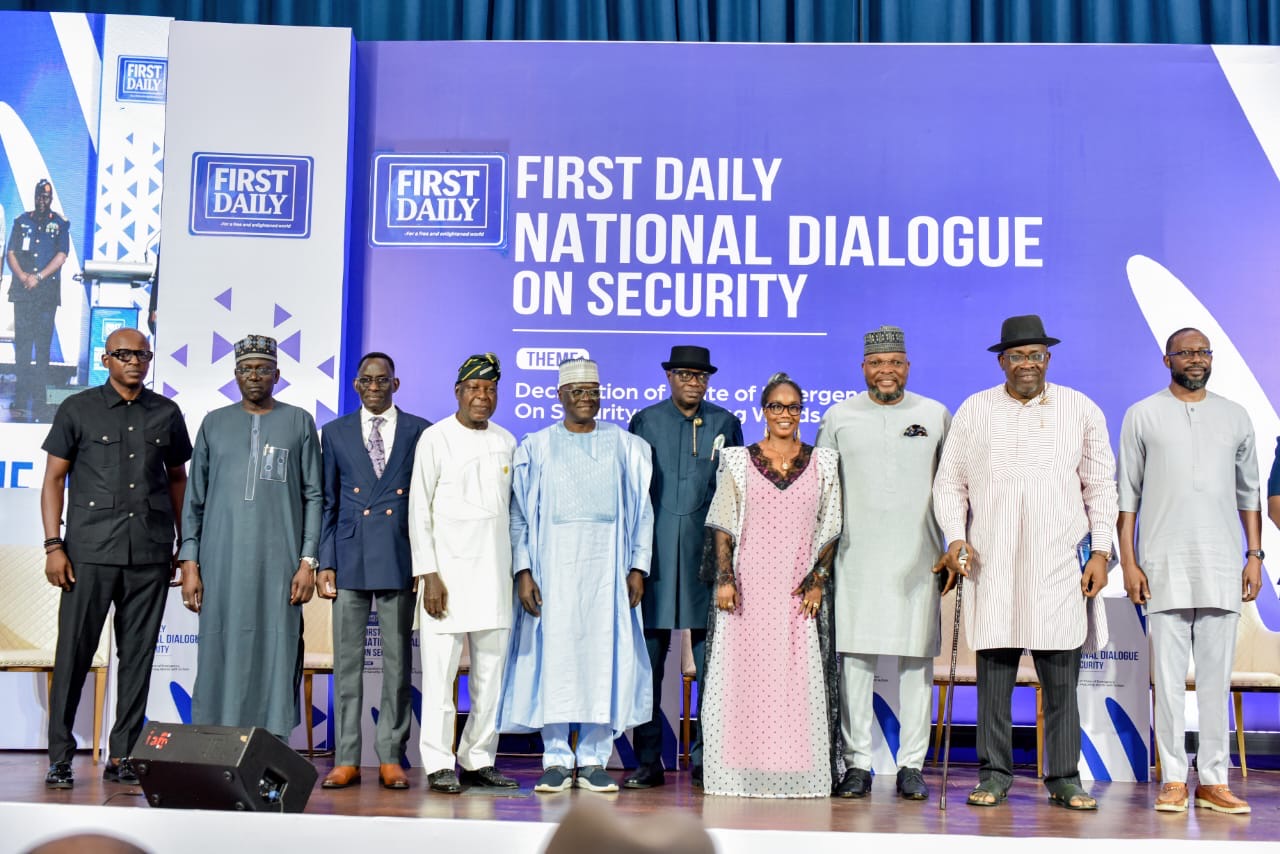
A broad consensus emerged on Tuesday at the First Daily Sixth Anniversary National Dialogue on Security, with former Chief of Defence Staff General Lucky Irabor (retd.), former Bayelsa State Governor and Senator representing Bayelsa West, Henry Seriake Dickson, former Chief of Defence Staff Martin Luther Agwai (retd.), Bayelsa State Governor Senator Douye Diri and other stakeholders calling for the establishment of state police, emergency funding for security agencies and far-reaching reforms of Nigeria’s security architecture to confront the country’s worsening insecurity.
The high-level dialogue, held at the Shehu Musa Yar’Adua Centre, Abuja, was themed “Declaration of State of Emergency on Security: Matching Words with Action.” It formed part of activities marking the sixth anniversary of First Daily Newspaper and brought together senior government officials, security experts, lawmakers, traditional rulers, legal practitioners, civil society organisations and members of the diplomatic community.
Delivering the keynote address, General Irabor said the declaration of a state of emergency on security should not remain a mere statement of intent but must be backed by decisive action.
“I believe the emergency on security was a statement of intent. It is necessary to fast-track the work beyond the talk,” he said.
The former defence chief urged the Federal Government to substantially increase funding for the armed forces and other security agencies, establish state police based on global best practices and develop Nigeria’s military-industrial complex to reduce dependence on foreign defence capabilities.
He also called on Nigerians to support security agencies through vigilance, accountability and active citizenship, insisting that the war against insecurity must be won through collective national commitment.
Speaking at the dialogue, Senator Henry Seriake Dickson blamed the collapse of Nigeria’s internal security system for the increasing deployment of the military across the country, warning that the armed forces have become overstretched by responsibilities outside their primary constitutional mandate.
According to him, while the military was established primarily to defend Nigeria’s territorial integrity, the weakening of the police and other internal security institutions has forced it to assume responsibilities for which it was not originally designed.
“The military’s primary responsibility is territorial integrity. Internal security was only meant to be a subsidiary mandate, but it has now become the main focus because the military is deployed everywhere,” Dickson said.
The former governor argued that Nigeria’s security challenges could not be solved through military deployments alone, calling for comprehensive reforms of the nation’s security architecture and stronger legislative measures to rebuild internal security institutions.
“It’s not just military, military, military. It’s better to fight the causes of criminality,” he added, stressing that addressing the root causes of insecurity was essential to achieving lasting peace.
Dickson also advocated sustained national conversations on security, saying Nigeria had yet to engage in sufficiently robust dialogue capable of producing enduring solutions to the country’s security challenges.
Co-chairman of the dialogue, General Martin Luther Agwai (retd.), said Nigeria’s security challenges had evolved into complex internal threats requiring a whole-of-society response.
According to him, security can no longer be left to the military and other security agencies alone, stressing that governments, the media, communities and citizens all have critical roles to play.
Representing Bayelsa State Governor, Senator Douye Diri, the Secretary to the State Government, Prof. Nimibofa Ayawei, reiterated the governor’s call for constitutional reforms to strengthen governors’ roles in Nigeria’s security architecture.
He argued that governors should be given greater constitutional authority to secure their states since they are held accountable by citizens despite lacking operational control over the police.
Ayawei described the ongoing constitutional amendment process as an opportunity to establish state police and devolve greater security responsibilities to sub-national governments.
Adding his voice during the panel session, development lawyer Frank Tietie called for emergency funding for security institutions, saying extraordinary security threats require extraordinary financial commitments.
He urged government to significantly increase funding for the police, armed forces and other law enforcement agencies while backing legislative efforts to establish state police with robust accountability mechanisms.
Political affairs analyst Mojeed Dahiru emphasised that national unity remains critical to security, urging leaders to respect Nigeria’s multi-religious character and promote inclusion, tolerance and equal treatment of all citizens.
Earlier in his welcome address, First Daily Publisher, Dr. Daniel Iworiso-Markson, said the national dialogue was deliberately designed as a non-partisan platform to generate practical, implementable solutions to Nigeria’s security crisis.
He urged participants to move beyond rhetoric by embracing intelligence-led and technology-driven security reforms capable of tackling terrorism, kidnapping, banditry and other violent crimes.
The dialogue featured keynote presentations, panel discussions and interactive engagements focusing on terrorism, banditry, kidnapping, communal violence, intelligence sharing, constitutional reforms, inter-agency collaboration and community participation in security management.
Participants agreed that reversing Nigeria’s security challenges would require stronger institutions, increased investment in security, constitutional reforms, improved intelligence gathering and sustained collaboration among government, security agencies and citizens.
The First Daily National Dialogue on Security was one of the flagship events commemorating the sixth anniversary of First Daily Media Network and reaffirmed the organisation’s commitment to fostering informed national conversations and policy-driven solutions to issues of critical national importance.