
By Israel Adamu, Jos
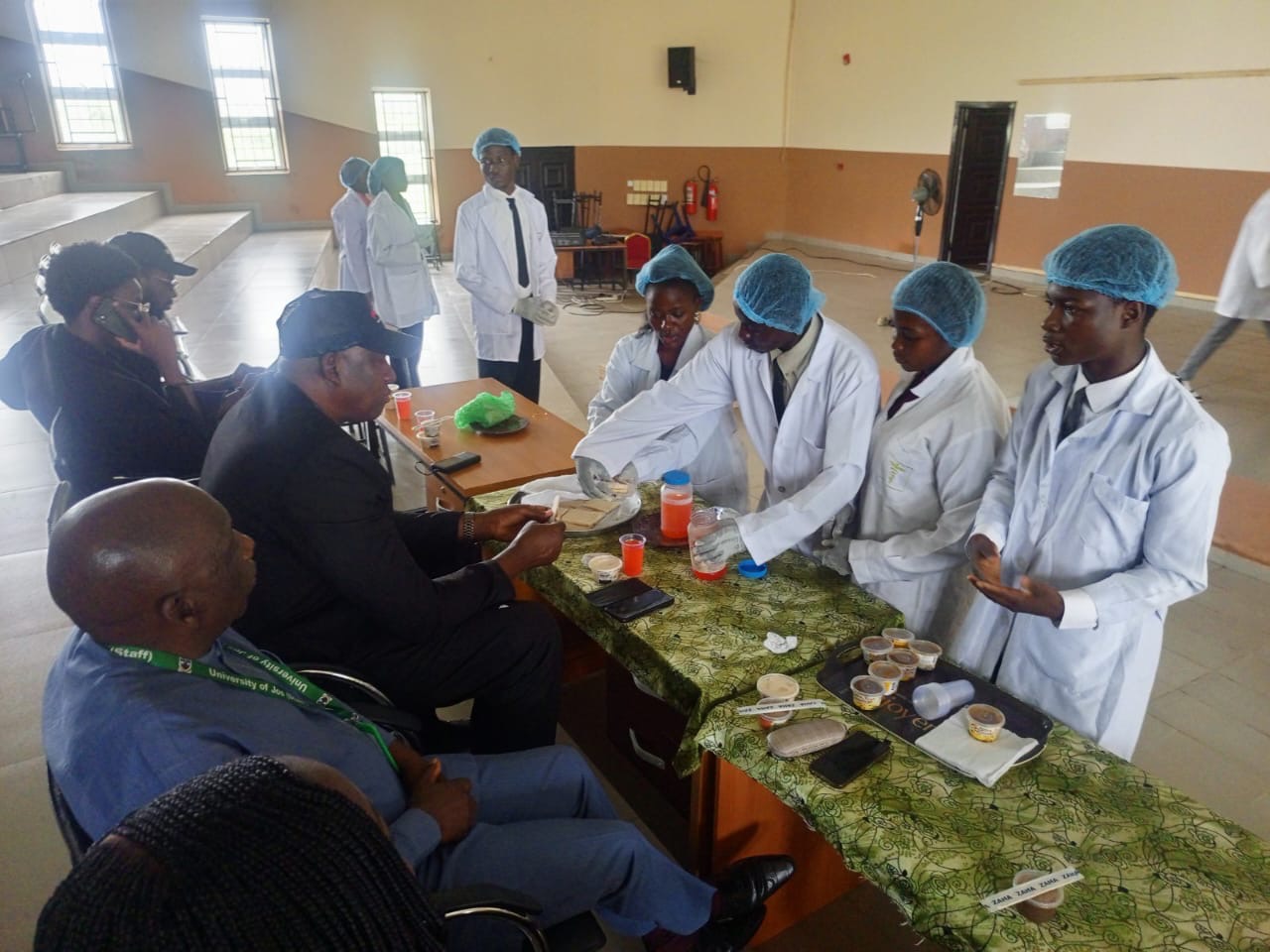
The University of Jos has declared that practical agricultural education remains critical to tackling Nigeria’s food insecurity, as 200-level students of the Faculty of Agriculture showcased locally processed food products, including bread, mayonnaise, pineapple jam and banana jam.
The exhibition, organised under AGR 206: Introduction to Food Science and Technology, featured products developed by the students as part of their hands-on training in food processing, preservation, packaging and value addition.
Speaking after inspecting the exhibition, the Deputy Vice-Chancellor (Academic), Prof. Joshua P. Cholom, said the practical display reflected the University’s commitment to producing graduates equipped with entrepreneurial skills rather than mere certificate holders.
According to him, the era when students depended solely on theoretical knowledge has passed, stressing that the University of Jos has deliberately embraced practical learning to prepare graduates for self-reliance and national development.
“I feel proud seeing what our students are doing because that is the essence of establishing the University of Jos. It is not just about learning theory; our emphasis has always been on blending theory with practicals, and this is exactly what we are witnessing today.
“These products demonstrate that the students have successfully translated what they learnt in the classroom into practical solutions,” he said.
Prof. Cholom described the University of Jos as a world-class institution that continues to attract students from across Nigeria and beyond, noting that the university has earned recognition for academic excellence and recorded one of the highest numbers of international students among Nigerian universities.
He appealed to governments at all levels to increase investment in tertiary education by expanding infrastructure and providing adequate funding to enable more qualified candidates gain admission.
According to him, the institution receives over 50,000 applications annually but is unable to admit many qualified candidates due to inadequate facilities.
The Deputy Vice-Chancellor expressed confidence that faculties of agriculture across Nigerian universities possess the capacity to contribute significantly to ending food insecurity if adequately supported.
“I am convinced that if government provides the necessary resources and substantially increases investment in universities, particularly faculties of agriculture, they have the capacity to help feed this country through research, innovation, crop production, livestock development and food processing,” he stated.
Also speaking, the Plateau State Commissioner for Water Resources, Hon. Bashir Lawandi Datti, commended the students for their creativity and practical demonstrations, urging them to remain focused and committed to acquiring skills that would make them self-reliant after graduation.
He said agriculture remains one of the most viable sectors for Nigeria’s economic growth and food sufficiency, adding that the knowledge and practical experience acquired by the students would contribute meaningfully to national development.
He encouraged them to continue exploring innovative ways of adding value to agricultural products and positioning themselves as future employers of labour.
The course lecturer, Prof. Olusegun Osibanjo, said the course was introduced under the Nigerian Universities Commission’s Core Curriculum and Minimum Academic Standards (CCMAS) to equip students with practical knowledge in food science, technology and family life management.
He explained that the curriculum combines food science and technology with family and consumer sciences to expose students to modern methods of food production, processing and household food management.
According to him, students are taught not only how to produce food but also how to apply science and technology to process, preserve and add value to agricultural products for commercial purposes.
Prof. Osibanjo, a specialist in food science and technology, said the programme is designed to expose students to the immense opportunities within the agricultural value chain and encourage entrepreneurship through value addition.
He affirmed that the Faculty of Agriculture has the capacity to contribute meaningfully to addressing Nigeria’s food security challenges.
“Food is essential to human existence. Every other business may fail, but people cannot do without food. That is why agriculture remains critical to national development. We have the capacity to produce food for the nation,” he said.
Earlier, the students, working in groups, presented products developed from locally sourced agricultural materials and were assessed on processing methods, production procedures, packaging techniques, cost analysis, production time and overall product quality.
Among the products displayed were bread, mayonnaise, pineapple jam, banana jam and other value-added food items, demonstrating the students’ growing competence in food science, technology and agribusiness.
Our correspondent reports that the exhibition formed part of the Faculty of Agriculture’s drive to strengthen practical learning, innovation and entrepreneurship, with the university expressing optimism that graduates equipped with such skills would play a vital role in boosting food production, agro-processing and Nigeria’s quest for sustainable food security.