
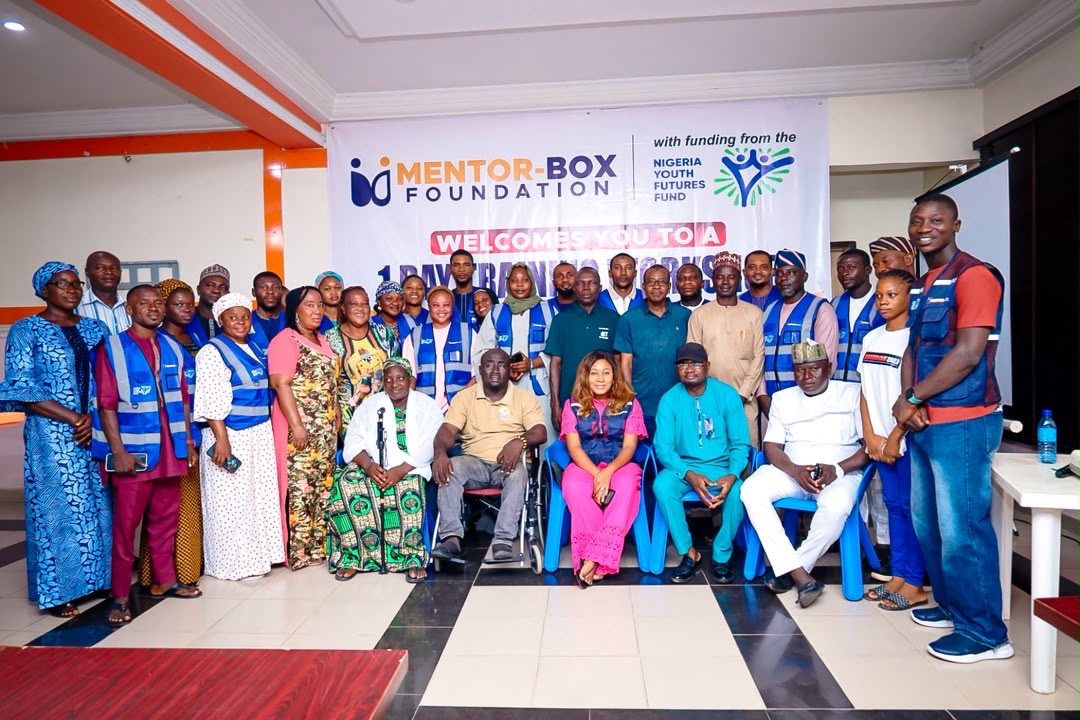
In a bid to enhance transparency, grassroots accountability, and social inclusion across local government administration, Mentor-Box Foundation, with funding support from the Nigerian Youth Future Funds (NYFF), has organized a specialized capacity-building training workshop for local government officials and youth advocates in Kogi State.
The event, tagged the Kogi Gender & Disability Responsive Governance Project (K-GDRGP), took place on Friday, October 23, 2026, in Lokoja.
The workshop convened 21 Local Government Youth Accountability Cluster Members alongside key council administrators, including Directors of Local Government (DLGs) and Local Government Finance Officers. The core objective of the session was to deepen stakeholders’ understanding of Gender and Disability Responsive Budgeting (GDRB) and foster institutional mechanisms for inclusive public spending.
Delivering the key address on the core objectives of the project, the Executive Director of Mentor-Box Foundation, Eunice Emmanuel-Agada, emphasized the urgency of embedding Gender Equality and Social Inclusion (GESI) into state policies, administrative frameworks, and public spending. She emphasized that the initiative aims to transform social protection mechanisms into sustainable economic productivity.
Reinforcing these objectives, Mr. Success Adejoh Sunday led a technical session on the fundamentals of Gender and Disability-Responsive Budgeting (GDRB). Participants were trained to scrutinize government budget allocations , capital expenditure releases, and actual project execution to ensure public funds yield observable results.
Adejoh further guided participants on analyzing local government financial documents, capital expenditure reports, and project specifications to ensure that approved funds match actual execution on the ground.
Co-facilitator Mr. Ibrahim Danasebe Yakub addressed the necessity of inclusive infrastructure in public service delivery, pointing out that primary healthcare centers and community facilities are often built without consideration for accessibility, safety, or PWD needs.
Yakub urged local councils to adhere strictly to statutory protections, including the Violence Against Persons (Prohibition) Act (VAPP Law), and align local planning with legal frameworks that safeguard vulnerable groups.
He challenged participants to dismantle the assumption that a public facility serves everyone equally, urging local councils to prioritize accessible physical infrastructure, safety measures, and compliant mechanisms at primary health centers and civic facilities.
To sustain continuous oversight, the workshop introduced an inclusive budget scorecard designed for independent field monitoring by youth accountability actors. Following the training, cluster members will deploy across target Local Government Areas to evaluate public projects, gather field evidence, and engage council leadership in constructive advocacy dialogues aimed at promoting inclusive governance policies.